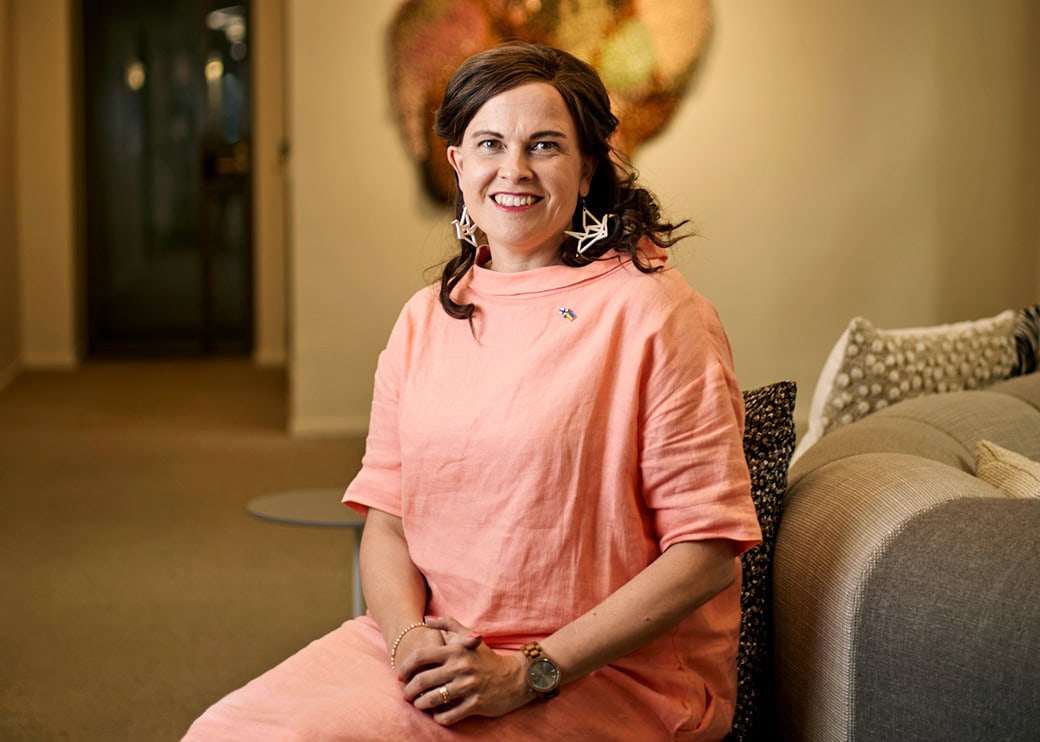
Raising the higher education rate is Finland’s trump card for the future
Minister Mari-Leena Talvitie’s goal is to open the doors of higher education institutions to at least every second young person. By increasing RDI funding, she wants to secure a strong capability to innovate for Finland in the future. At the same time, she is aware of the difficulties of increasing the education level and research…
Text Minna hiidensaari images sami heiskanen English translation Marko Saajanaho
“Know your partners.” In these three words, Minister of Science and Culture Mari-Leena Talvitie summarises one essential strength of Finnish society and education.
“Finland is a trust-based society. We also share our values and methods with, for example, our Nordic partner countries. We must know our partners in order to conduct high-quality research based on western values now and in the future. This is especially important in the current global situation.”
Talvitie started as Minister of Science and Culture this January. Her most concrete goal is to open the doors to higher education to at least every second young person in order to boost the sagging level of education among young adults.
In the government’s mid-term session this spring, an investment of a total of 100 million euros into the level of education was agreed on.
“Higher education institutions require effective management, sufficient resources, and sustainable decisions. On the other hand, it is obvious that no allocation of funds will ever totally satisfy everyone.”
“As part of this, we decided on a study voucher for young people, which would allow them to study for free for one semester in an open university or university of applied sciences should they not have received a study place in the joint application period.”
The goal is for the study voucher, currently on the budget negotiations list, to be in effect by late 2026.
The minister’s second main goal is to provide students with sufficient knowledge, skill, and motivation.
“All of these are methods for building a better Finland. People from different backgrounds being able to receive higher education all over Finland is our trump card.”
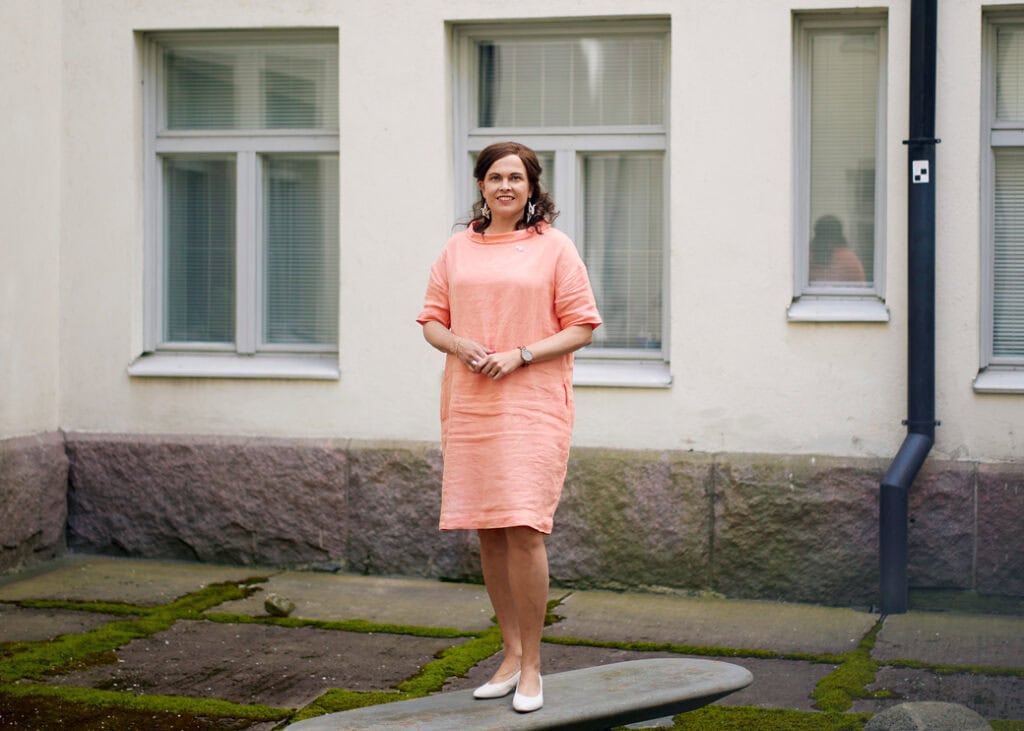
In the same breath, the minister notes that this trump card is not a foregone conclusion. There are many phenomena challenging the building of a better Finland. For example, learning difficulties have been identified as late as in higher education. That is why Talvitie considers it vital to improve the quality of the learning path that starts from early childhood education.
“More mathematics, Finnish, and literature lessons are being added to primary school while remedial education will be available in secondary schools. Timely learning support, which went into effect this August, hopefully means fewer students in higher education will require support as we enter the 2030s.”
Funding grows in one area and shrinks in another
Competition for funding and, for example, result-oriented criteria in funding allocation cause pressure in research and teaching. How to ensure high-quality operation in higher education institutions when the overall funding decreases?
“Higher education institutions require effective management, sufficient resources, and sustainable decisions. On the other hand, it is obvious that no allocation of funds will ever totally satisfy everyone.”
According to Talvitie, the new research and development core funding being distributed to all higher education institutions is essential.
To attract more investment and solve the shortage of experts, new starting places are added to higher education institutions. How will the increased teaching and support costs caused by extra students be funded?
“I hope young people will be motivated to attain higher education and that through quality education, we can find innovations to create a more sustainable world. ”
The minister says the difficulties faced by higher education institutions with core funding and growing numbers of students are well known.
“However, funding has been allocated to the starting places added this term. Furthermore, nonrecurring funding has been increased. During this government term, research and development funding has been increased annually by 280 million euros. Starting in 2026, this funding will also be allocated towards higher education core funding.”
In this autumn’s budget outline, Minister of Finance Riikka Purra suggested freezing the university index to cut costs. Would this not specifically threaten to undercut the government’s goals to boost higher education funding?
“We in the government have prioritised the higher education indexes, and that remains the goal in the autumn’s budget session.”

How does Talvitie see development costs reducing academic freedom?
“Higher education in Finland has been developed in such a way that the institutions have strong autonomy. Freedom of science and highest education are protected by the constitution.”
While the overall picture is largely painted in dark hues, there are also bright signals. For example, Talvitie notes that the Academy of Finland stated in late spring that it has never had as much funding as it does at the moment.
The parliamentary RDI Working Group’s policy with the goal of boosting Finland’s research and development funding to four percent of the GDP by 2030 also helps bring a long-term approach to research work. The fact the business sector is committed to the goal is promising according to Talvitie.
Higher education institutions must have agency
This autumn, the minister’s agenda includes higher education and research vision work with a 2040 target horizon.
“The entire higher education sector must be involved for us to succeed at this.”
If the envisioned plans proceed as intended, what will Finland look like in the future?
“I hope young people will be motivated to attain higher education and that through quality education, we can find innovations to create a more sustainable world. For example, we are already seeing signs of inventions helping fight off climate change, such as in the food industry and carbon-free steel production.”
“It is crucial for higher education institutions themselves to have active agency, down to their staff and individual students.”
At the same time, the minister recognises the different approaches and interests of different academic fields and higher education institutions.
“Not everyone is oriented towards technical and economic areas, nor should they be.”
Should the Finnish higher education strategy focus more resolutely on certain areas or is evenhandedness preferable? Welfare, data economy, and defence security have been named as examples of major areas of focus.
Talvitie emphasises that the higher education field must have agency.
“It is crucial for higher education institutions themselves to have active agency, down to their staff and individual students. Contacts in the academic community and, for example, stories from and about Finland can build that agency.”
According to Talvitie, sharing information in society in general is an important way to bolster the agency of citizens.
“Small everyday examples in, for example, better city planning or supporting biodiversity can help with this.”
Mari-Leena Talvitie, Master of Science in environmental technology
Born: 1980 in Vaasa, Finland
Work: Minister of Science and Culture from 24 January 2025, Member of Parliament since 2015. Has served in the Parliament as Vice-Chair of the Administration Committee and been a member of e.g., the Education and Culture Committee, the Environment Committee and the Legal Affairs Committee. Before being elected to Parliament, chaired the Oulu City Council and Oulu City Executive and worked in the food industry and served as an assistant to several Members of Parliament.
Family: Husband and two daughters.
Hobbies: Reading, recreation in nature, fitness, and a variety of culture.
What are you known for in your work community? Being a reliable team player and a skilled and ever-considerate negotiator.
What are you not known for? Mari-Leena hand sanitiser in my bag since the 2014 European elections, enough to share. Reading and writing poetry. Buying and writing hundreds upon hundreds of cards.