Science is a community effort
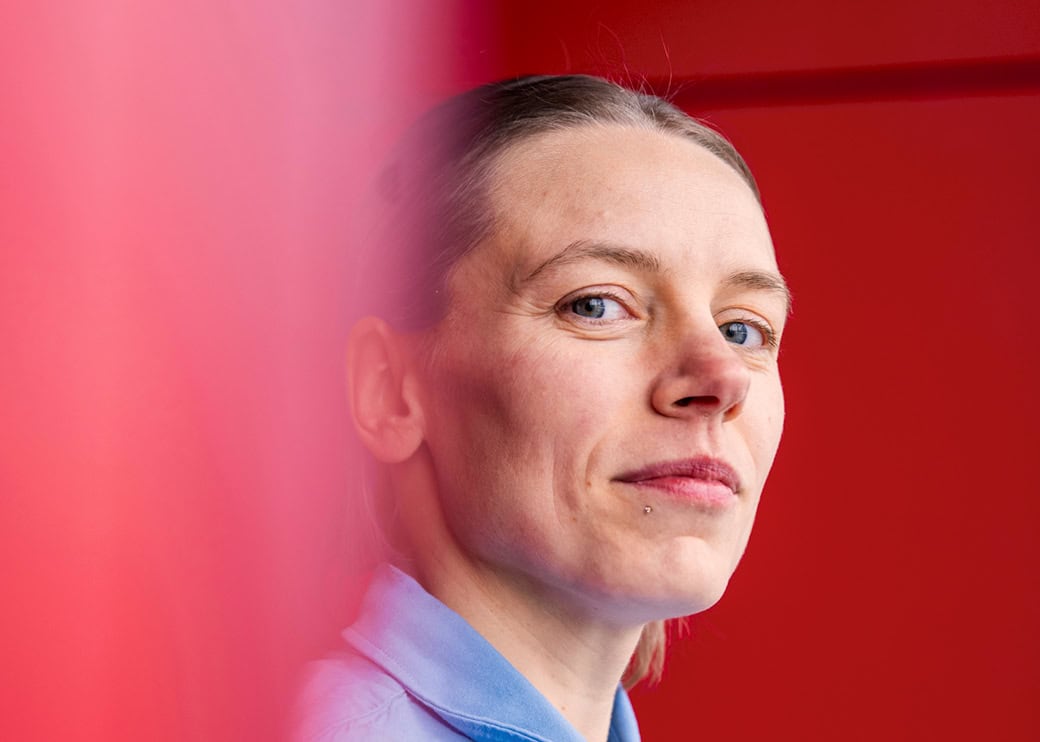
Media and communications researcher Veera Ehrlén believes that science is created together. She works with Young Academy Finland to build a community of researchers where expertise is shared, the voice of science is boosted, and research is made socially visible.
text Minna hiidensaari images vesa tyni
“Sports are an enormously interesting research subject because they are such a central part of our culture. At the same time, many issues of equality are lagging behind in sports compared to the rest of society. Even though plenty of advanced technology is used in sports and decisions are made based on data, attitudes in sports media, for example, can be backwards”, media and communications researcher Veera Ehrlén states.
The intersections of sports, exercise, media, and communications technology especially from the equality and normativity point of view have formed a common thread running throughout her research career.
The burden of history is one of the elements explaining backwards attitudes and strict norms.
“In sports, the comparison is usually to the physically strongest one. Women were also banned from many competitive sports for a long time.”
Ehrlén sees a special strength in her role as a researcher – she can highlight problems regarding, for example, media practices and attitudes because her interviewees talk about their experiences anonymously.
“In sports journalism, female journalists still have to prove their competence. I wish they could do their job in their own way without pressure to adapt to the prevalent practices of the field.”
Based on her research, Ehrlén estimates that wider and more diverse perspectives than those we are used to would also bring new readers to sports journalism.
Structural bias challenge equality
Currently, Ehrlén is investigating the intersections of media and sports from a gender and sexual minority perspective. An ongoing University of Turku study about sexual and gender minorities is part of a larger group of projects.
According to her, the internationally controversial question regarding the status of trans athletes reflects a phenomenon stretching far beyond sports.
“Values and attitudes in sports trickle down from top-level sport to casual exercise – to how the physical capacity of children is assessed, how exercise is supported, and how people act in social situations. At the same time, it is decided which sport is for whom, what you are allowed to look like and how you are allowed to dress. The discourse is happening in the research community as well. Opinions on trans athletes split the field.”
Even though attitudes have become more tolerant, the social media megaphone highlights the extremes.
The operating logic of mass and social media escalates disputes.
“Even though attitudes have become more tolerant, the social media megaphone highlights the extremes. Scandals and the loudest ones get a lot of attention. Sports in general are associated with strong feelings.”
From childhood ski trails to academic endurance sports
Ehrlén’s interest in social research of sports comes from her background.
Ehrlén competed as a cross-country skier from age 10 to 20. Sports were present at home as well; her father had a semi-professional bicyclist background. Her childhood sports club, Tampereen Yritys, improved her understanding of the social reach of exercise, such as doing things together and defending those who are weaker.
After competing her matriculation examination, Ehrlén wanted to do something exercise-related.
“I was massively excited when I discovered Sports and Health Sciences at the University of Jyväskylä. Then I found a minor in Communications and combined these for my master’s thesis. When my fellow students complained about the difficulty of writing a master’s thesis, I secretly enjoyed writing it. However, I never thought I could be a researcher, and there were no role models in my family.”
Sometimes, one person recognising potential and saying it out loud is enough.
“One researcher had read my master’s thesis and asked me to apply for project funding with them.”
One researcher had read my master’s thesis and asked me to apply for project funding with them.
That project eventually failed to materialise, but the spark remained. Ehrlén went more in-depth on the themes of her master’s thesis in her doctoral thesis, in which she studied digitalisation, social interaction, and community intertwining in recreational sports cultures.
“One of my research colleagues said you can easily see I am a former competitive athlete.”
Ehrlén reckons the comment referred to her way of conducting research in a determined and disciplined manner.
“I do things carefully. I don’t look to the sides too much, focusing on what I am doing instead. A strength of mine is the ability to relax in a situation and carefully consider how to accomplish the set goals.”
I am lucky to be able to study what I find interesting.
PTo Ehrlén, research work at its best is those moments of epiphany – when the different threads connect and the whole becomes clearer. She has stated that taking advanced mathematics in upper secondary school was useful.
“That taught me a systematic approach and unpicking data analytically, and also that sometimes you have to take idea leaps to go forward.”
Ehrlén appreciates the confidential interview situations in her research work.
“I really like meeting people. I am lucky to be able to study what I find interesting. On the other hand, research work has its limit. My life has balance when I read, exercise, and bake.”
You are there, biting
Ehrlén wants to use research to increase awareness of the field’s difficulties, influence the structures of sports and exercise, and promote equality.
“Changes come from the combined effects of several factors. Still, just one person may make a surprising difference.”
As an example, she mentions Swedish researcher Marit Stub Nybelius, who is an expert on women’s ski jumping and also serves as an international judge in the sport.
For Ehrlén, influencing through science is increasing multivoicedness.
Changes come from the combined effects of several factors. Still, just one person may make a surprising difference
“I do not easily share my opinions but talk about different perspectives based on the understanding gained from research.”
Despite Ehrlén considering her own research influence to be limited, she has encountered results from her work even in surprising situations.
“One time, I was talking about the experiences of female coaches and their needs for change when Leena Laine, a trailblazing sports history scholar and Licentiate of Philosophy, stood up from the audience and and said ‘Wonderful to see my work bear fruit. Now you’re there, biting.’”
However, research data “biting”, meaning the data being brought to the wide audience and political decision-makers to use is far from a certainty. Ehrlén reminds us that researchers are generally not trained to talk about their work or appear in public.
“Universities should have clearer paths and support structures for this. Young researchers in particular have a hard time getting their voices heard.” This need is met by Young Academy Finland, founded in 2017 with support from the Emil Aaltonen Foundation. Ehrlén is a member of the Academy’s board. This multidisciplinary community for researchers under 40 works to improve the status of science and young researchers in society. For example, Young Academy Finland operates the “Meet a researcher” service and publishes the Mene ja tiedä online journal aimed at young people.
The many influencing methods of organisation work
Young Academy Finland accepts about 15–20 new members each year through invitations and applications. Academy members gather regularly to discuss science and research from perspectives including freedom of science, openness, science education, and political influencing. Academy members actively participate in cooperation via national and international channels.
“We make statements in public as well; about freedom of science, for example.”
The “Meet a researcher” remote visiting service is a low-threshold place for young researchers in particular to practise popularising science and find a way to talk about their own research. Currently, the pool of reseachers asked to visit schools and secondary schools consists of approximately 800 researchers. Students or teachers send visiting researchers anonymous questions beforehand.
Meeting young people brings hope to Ehrlén.
“I am always impressed when I get to talk to young people. They are very aware of world politics and the state of society.”
“Participating in Young Academy Finland has definitely been the highlight of my academic career. I have been able to sit in places with more significant influence in terms of solving equality issues, for example. Cooperation with, for example, All European Academies and the International Science Council is very meaningful.” Ehrlén reminds us the policies of large organisations also affect the work of researchers. One example of this is the quantity of publications no longer being as heavily emphasised in a research career as it once was.
Communal sharing instead of competition
Ehrlén also serves as the chairperson of the Finnish Association for Media and Communication Studies (Mevi ry).
“Through organisation work, we can create conditions for positive change, hit society’s mechanisms, and expand discourse. Equality is more important than ever in this global situation. We create relationships and do not compete against each other.”
Community is the guiding light in both her research and positions of trust. She reminds us that at its core, science is a community effort.
“Even temporary sharing can be meaningful to a person. Everything is built on previous work. Understanding of the communal nature of science should be increased instead of having researchers focus on building their own brands and collecting quotations. When a project involves people with different ways of thinking, quality research is the result. Personally, I often reach out to gender scholars to perceive the placement of my research work in the historical continuum.”
Ehrlén’s dream project is a multidisciplinary project in which sports, gender, and technology are studied by researchers from different fields.
“It could include experts from fields outside my expertise, such as data sciences and law.”
Doing things together, being equal, and exercising also meet in her new hobby – sabre fencing.
“At the Young Academy Finland Christmas party, we practised opening a champagne bottle with a doctoral sword. When I looked at the sword on the wall at home (gifted to me by my spouse), I thought that if a woman has a sword on her wall, she must also know how to use it.”
She describes sabre fencing as a fast-paced sport.
“My coordination is constantly tested.”
What kind of skills does Ehrlén see as particularly important for a researcher in the future? “The ability to look widely across disciplines so we can solve social issues. Europe can blaze the trail here. We can influence how scientific data is considered in political decision-making.“
Veera Ehrlén, Doctor of Philosophy
Work: Postdoctoral Researcher at the University of Turku, Young Academy Finland board member, Chair of Finnish Association for Media and Communication Studies (Mevi ry).
Born: 1989 in Suodenniemi, Finland.
Family: Spouse and two children.
Hobbies: Cross-country skiing, sea swimming, Pilates, reading, sabre fencing.
What are you known for in your work community? My notes, which I constantly write in my notebook and always start looking for in the middle of meetings.
What are you not known for? I can impress people (children) with my abilities to create believable character voices when reading books aloud.