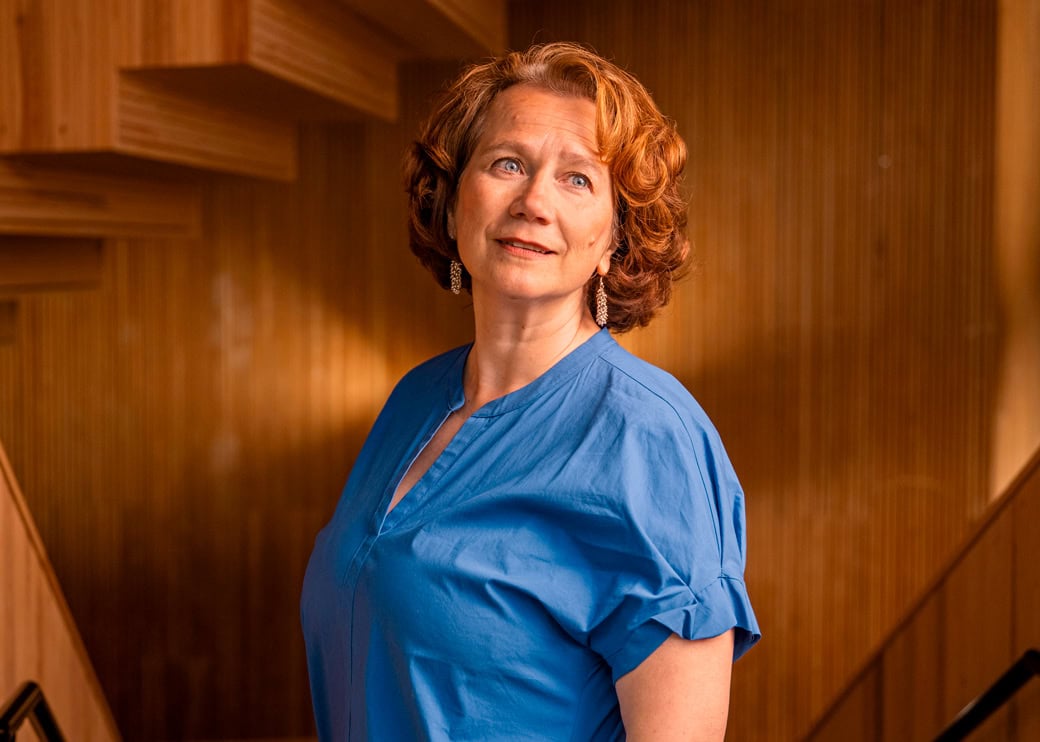
Future-gazer, enabler, and architect of change
Anu Haapala builds a better future with information, blazes a trail for as many points of view as possible, and ponders the meta skills required in the future. She wants to keep the curriculum and research focus at the heart when needs for university education reform are considered.
Text Minna hiidensaari images vesa tyni english translation marko saajanaho
Director of Development of the University of Helsinki’s Teaching and Learning Services sector Anu Haapala summarises the mission of the Teaching and Learning Services into one clear picture:
“The best end result is studies progressing so smoothly that the student does not even notice the service organisation.”
To teachers and management, everyday support means smart digital tools for education planning and expert help such as pedagogical sparring.
An expansion of all university services is currently ongoing. The Director of Development makes a point that the work under the hood has just begun. The core method is leading with different database data and statistics.
“Decisions must be based on evidence and rely on the best possible information available.”
In her view, leading through information has already improved significantly.
“For example, we use a systematic annual monitoring system for education programmes. Deans and vice-deans can develop curricula using a monitoring system based on ten different metrics.”
Haapala describes herself as tech-religious. In the same breath, she states that we must know what to do with the time saved by using artificial intelligence, for example. She is also aware of the additional burden brought on by digitalisation.
“You must pay heed to whom the work trickles down to. The change is slow.”
Support for this moment, gaze a hundred years into the future
In addition to strategic leadership of the Teaching and Learning Services, Haapala’s extensive field of work includes the unit’s financial responsibilities. Furthermore, she works to facilitate diverse learning environments and international education. There is also room for continuous learning services, tutoring coordination, student application services, study and career guidance, and close co-operation with student organisations. She does a lot of broad, cross-sectional co-operation with university services.
In development work, one must look far ahead.
“The university’s role in the changing world is to apply and promote values science believes in. We should be able to consider what these values will mean in a hundred years instead of just thinking if AI is going to take jobs away, for example.”
At the same time, there is a fight to resolve current conflicts. Building a better future is under pressure in all social sectors due to reduced economic resources.

“Economy discourse has forced its way to the university as well. That is just a fact.”
Reduced funding is also felt by Haapala’s organisation. When she took up her position, she had 350 subordinates. Some of the staff transferred to other university services units. Now there are 325 staff.
Services of equal quality as the goal
Haapala started as Director of Development in April 2024. An extensive organisation reform was immediately waiting on her desk.
“Job descriptions had become fragmented and responsibilities were not clearly determined”, she reminisces on her start.
Early in the reform, a survey was conducted for the organisation’s employees, allowing them to bring up their ideas. Haapala met the staff on a team-by-team basis several times and began monthly events with her close team. In different phases of the reform process, managers and employees discussed the change.
“Economy discourse has forced its way to the university as well. That is just a fact.”
Haapala quickly noticed that the large expert organisation had a strong consensus on the need for change. The division of roles was in dire need of clarification, and unnecessary overlaps had to be cleaned up to facilitate efficient work.
In a large, multidisciplinary university, the needs of different disciplines are very individual, which means service resource allocation must be considered per discipline. The faculties are tremendously different to each other.
“Due to the different fields having different approaches, equal services cannot be arithmetically equal. That simply is not the winning formula.”
However, services of equal quality can be strived for. For example, HelsinkiUni Help, which was adopted by all university services in the autumn of 2025 and also uses AI, also supplements the Teaching and Learning Services. Campus-specific service units help resolve field-specific matters.
From witnessing processes of change to an architect of change
Haapala has extensive experience of developing operating processes, pedagogy, and continuous learning in education organisations. The Director of Development is a Doctor of Philosophy (Education) and has worked, for example, as a teacher and researcher at the University of Joensuu (now the University of Eastern Finland) and served as the Director of RDI-activities at the South-Eastern Finland University of Applied Sciences for ten years. During her tenure there, she built the organisation’s research, development, and innovation strategy.
Witnessing and actively influencing processes of change has dictated Haapala’s career. The merger of the Universities of Joensuu and Kuopio was in the planning phase when she moved on to work at the Eastern Finland Provincial Government. The provincial government was later shaped into AVI (regional state administrative agency) and ELY (Centre for Economic Development, Transport and the Environment). At the Mikkeli University of Applied Sciences, she was involved in merger planning when the Kymenlaakso and Mikkeli Universities of Applied Sciences were fused into one.
”These experiences provided a fertile ground for my professional growth. My current job combines all knowledge and experience I have accumulated over the course of my life.”
The changes have also taught her about the human pains that are part of the processes. Haapala’s experience indicates the readiness for change can be high, only for the situation to turn difficult when being personally affected brings uncertainty. One’s agency may take time to find its place before a new direction is found.
“My most important lesson for leading an expert organisation is that everyone must be faced primarily as a human being.”
The significant increase in mental health challenges faced by students are a modern-day phenomenon that must be taken into account to facilitate efficient studies. Mental health support services are a different unit’s responsibility, but the Teaching and Learning Services also investigates the processes from the sustainable wellbeing point of view. In co-operation with the faculties, the unit develops sustainable education studying the future sustainability of education and takes students’ individual needs into account. At the same time, matters regarding teaching staff’s wellbeing are also ensured. “Pedagogy often has solutions to benefit the pedagogic wellbeing of both the student and the teacher. The development work also considers the known effect of the need for community on wellbeing.”
From a teaching spark to a leader’s growth path
Haapala was originally meant to become a schoolteacher. She already found the burning desire for teaching work early in life. A new horizon opened during the master’s phase of her University of Joensuu studies, on an exchange in England. The themes of Futures Studies sucked her in so powerfully that the topic of her master’s thesis eventually grew in depth all the way to a doctoral thesis. Her research was about the way young people perceived their future and supporting thinking processes through nurture.
Visionary abilities, prediction, and developing thinking skills related to these have been the common thread of Haapala’s career.
“There are many similarities between teaching and management. A teacher’s job is to get the student to shine. Meanwhile, management promotes recognising strengths while taking things forward as a community.”
Haapala leads by offering participation and responsibility, but as a counterpoint, she requires clarity and honest feedback about problems.
“There are many similarities between teaching and management. A teacher’s job is to get the student to shine. Meanwhile, management promotes recognising strengths while taking things forward as a community.”
“The most rewarding part of my job is when a common desire for development is found along with a consensus on where we are headed. However, approaches must be based on something. Leadership cannot be one person giving commands.”
Growing into a leader was not a simple process for someone orienting herself in the world with a strong teacher identity.
“I indirectly ended up in jobs that required managerial duties, and the idea of me as a manager felt uncomfortable.”
The Mikkeli University of Applied Sciences vice rector can be thanked for the project leader and senior teacher finding the courage to seek out management positions.
“The university is often seen as a competitive community. However, we should focus on a common goal, which is to secure a new, better future for young people.”
Haapala states that a good leader needs to recognise their own qualities, including weaknesses. She reckons her strength, looking far ahead and high up, also has its flip side.
“When meeting people, I have to remember that something that seems like a small matter to me means the entire world for this person. Large wholes become concrete through small things.”
Haapala emphasises wider, value-based meta skills with a genuine social impact. Direct working life requirements only come after this.
“In the last decade, there has been increasing talk about entrepreneurship skills that are useful in all working relationships and forms of work, where the whole includes interaction skills, innovative thinking, the ability to be daring and trust oneself, and specific understanding of business economics content.”
Diverse competence is also supported by national systemic cross-studying, which helps an individual student direct their path between different fields of science.
Haapala illustrates the ongoing change with an international example from the U21 university network.
“The network’s conversations emphasised ethical and social skills, workplace wellbeing and the role of AI. These skills go seamlessly hand in hand with the curricula of different fields.”
Sense of community is one of the four core values of the University of Helsinki.
“The university is often seen as a competitive community. However, we should focus on a common goal, which is to secure a new, better future for young people.”
She also highlights the importance of community with a research-based observation related to the progression of studies.
“Community support has been recognised as meaningful in the progression of studies. Those working at a common pace together with their fellow students use their time more efficiently and graduate quicker. It has been observed that these benefits continue when moving into working life.”
In an era of increased remote studies, Haapala emphasises the importance of personal meetings.
“Face-to-face interaction has values that are easily lost remotely. The value of work is much more than just doing the work. You should also look at the matter like this: even if you do not feel you need the community, the work community needs you specifically.”
In an era of knowledge-based society and the AI revolution, Haapala highlights the education (Translator’s note: The Finnish word “sivistys” used by Haapala can mean education, culture, civilisation or some combination of those, and has been noted in an earlier Acatiimi article as a tricky term to translate. Education seemed the most relevant in this context) ideal as an important goal.
“Information only refines into education when we examine it from many different perspectives. The credibility and reliability of the information deepen through different interpretations.”
Compassion is also an inseparable part of education.
“We must understand each other and meet everyone as a human being. This is something I want to hold onto.”
Anu Haapala, Doctor of Philosophy (Education)
Work: Director of development of University of Helsinki’s Teaching and Learning Services sector since 2024. Previously a lecturer and researcher at the University of Joensuu (now University of Eastern Finland); Administrative Officer in Education in the Eastern Finland Provincial Government; and teacher, Director of Research and Development, and Director of RDI-activities at the Mikkeli and South-Eastern Finland Universities of Applied Sciences, among other positions.
Board member of public and private organisations.
Family: Three adult children.
Born: 1971 in Kiuruvesi, Finland.
Hobbies: Skiing, canoeing, and hiking, tending to a flower garden, and reading.
Also enjoys various events, theatre and concerts.
What are you known for in your work community? Realistic idealism, analytical questions, and a positive orientation for the future.
What are you not known for? Diverse organisational work in the field of sport and exercise, e.g., in the Finnish Olympic Committee’s female leaders network.